
Every August, San Clemente’s streets fill back up with kids walking and biking to school after a summer of comparatively open roads, and every August, that transition catches some drivers off guard. Parents spend the weeks before school starts thinking about supplies and schedules; drivers rarely spend the same amount of time thinking about the fact that their commute is about to include far more child pedestrians and cyclists than it did in July. This post covers what California law actually requires around schools and school buses, why the transition period carries elevated risk, and what parents and drivers alike should know.
School Zone Speed Limits: What the Law Actually Says
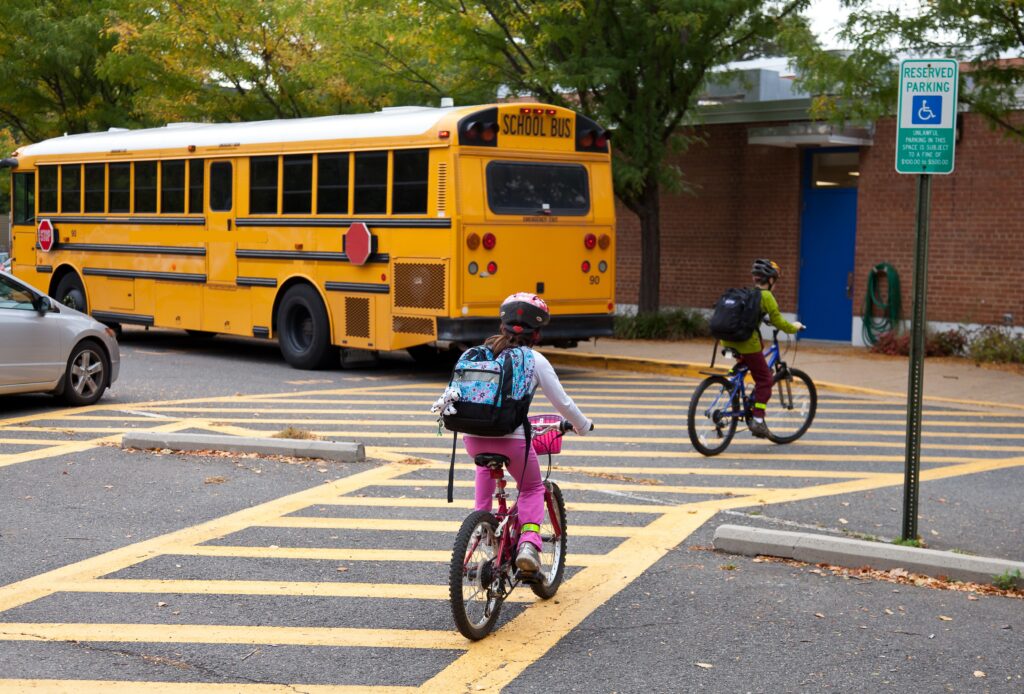
California Vehicle Code Section 22352 sets what’s called a “prima facie” speed limit — a default limit that applies unless a different limit is specifically posted — of 25 mph when passing a school building or school grounds while children are present, whether they’re arriving, leaving, or present during recess or lunch. This 25 mph limit applies based on the presence of children, not based on whether a flashing beacon happens to be active at that moment; Caltrans guidance is explicit that “when flashing” signage suggesting the limit only applies during certain times is not supported by California law. In some locations, particularly blind intersections or areas near railway crossings, the prima facie limit drops further to 15 mph.
It’s worth understanding the practical effect of this: a driver passing a school with children outside is legally required to observe the 25 mph limit regardless of whether they see a flashing light, and unfamiliarity with a specific school zone’s signage isn’t a defense to a citation — or, more importantly for an injured family, evidence that the driver was acting reasonably if a collision occurs at a higher speed.
The School Bus Stop Law: One of the Most Serious Traffic Rules in California
Few traffic rules carry consequences as severe, or as consistently misunderstood, as California’s school bus stop law under Vehicle Code Section 22112. When a school bus activates its flashing red lights — located at the top front and rear of the bus — every driver approaching from either direction, on either side of the road (with narrow exceptions for divided highways with a physical median), must come to a complete stop and remain stopped until the lights turn off. This isn’t limited to drivers behind the bus; a driver approaching from the opposite direction on an undivided road must stop as well, since children may be crossing from either side.
For younger students — prekindergarten through eighth grade — the law requires the bus driver to personally escort them across the street using a hand-held stop sign, walking in front of the bus and confirming that all children and other pedestrians are clear before the bus moves again. This is a meaningful legal detail: if a driver fails to stop, or begins moving before the lights go off, the fact that a bus driver was actively escorting children across at the time can significantly strengthen a family’s claim, since it establishes exactly how foreseeable the presence of a child in the roadway was at that moment.
Violating this law carries some of the most serious consequences in the Vehicle Code for a moving violation — fines that can reach $1,000 and a one-year license suspension for a first offense involving passing a stopped school bus. That severity reflects how dangerous this specific scenario is: a child obscured by the bus itself, stepping into a roadway where a driver may not expect cross-traffic, with very little reaction time available to anyone involved.
Why the Late-August Transition Carries Elevated Risk
The reasons this seasonal shift creates real risk go beyond simple unfamiliarity. Drivers who have spent the summer on relatively open residential streets need to re-calibrate their expectations quickly, and that adjustment period doesn’t happen instantly just because a calendar flips to a new school year. A few specific patterns tend to show up during these first few weeks:
Morning commute timing overlaps with drop-off traffic for the first time in months. Parents driving to work suddenly share the road with parents driving carpool, buses making frequent stops, and kids walking or biking along routes that saw minimal traffic all summer. This compressed timing window, combined with drivers who haven’t yet adjusted their routines, is a recurring contributor to school-zone-adjacent incidents in late August and early September.
Young or new riders are often the least experienced children on the road. Kids who received a bike or e-bike over the summer, or who are walking or biking to a new school for the first time, tend to have less-developed judgment about traffic gaps, driveway hazards, and predictable positioning than older, more experienced student riders. Drivers in school zones should expect a wider range of predictability in how children move than they might assume based on prior years’ experience with the same route.
Crossing guards and updated signage take a few weeks to become fully familiar to everyone. New crossing guard placements, updated school zone signage, or changes to drop-off traffic patterns from the prior school year create a genuine adjustment period for both drivers and families, during which miscommunication and misjudged gaps are more likely.
Teen Drivers Add Another Layer of Risk During This Season
It’s worth specifically flagging a driver category that gets less attention than adult commuters but shows up disproportionately in school-zone incident data: newly licensed teenage drivers, often driving younger siblings to school for the first time or navigating an unfamiliar drop-off routine of their own. California’s graduated licensing system restricts newly licensed teen drivers from carrying passengers under 20 (with exceptions, including siblings, for the first twelve months of licensure) and from driving between 11 p.m. and 5 a.m., but it doesn’t restrict daytime school drop-off driving, which means a genuinely inexperienced driver is often navigating a congested, pedestrian-heavy school zone during exactly the peak-risk morning window discussed above. If your family relies on a teen driver for morning drop-off duties, extra practice specifically focused on school zone navigation — not just general driving skill — is a reasonable and worthwhile investment during the first few weeks of a new school year.
What Parents Can Do
- Practice the route before school starts, and again in the first week. Walking or biking the actual route with your child — noting specific intersections, driveways, and any spots without a marked crosswalk — builds the kind of route-specific awareness that generic “look both ways” advice doesn’t fully cover.
- Reinforce the rule about never running for the bus. As California’s own school bus safety guidance emphasizes, a child chasing a departing bus, or darting into the street because the bus is pulling away, is one of the most common scenarios that leads to a serious or fatal injury. The next bus is always safer than the sprint to catch this one.
- Make sure young cyclists and e-bike riders know the rules that actually apply to them. As covered in our posts on cycling the beach trail and e-bike insurance gaps, e-bike riders under 16 face specific restrictions, and all bicycle riders are subject to right-of-way rules that differ in some respects from pedestrian rules. A child riding to school for the first time benefits from understanding these distinctions, not just generic “be careful” guidance.
- Choose visible clothing and equipment, especially for early morning routes. Southern California mornings in late August and September can still be dim enough, particularly with marine layer conditions common along the coast, that visibility matters more than it might seem on a clear afternoon.
What Drivers Can Do
- Treat every school zone as active, even without children immediately visible. The 25 mph limit under CVC 22352 applies based on the presence of children in the area, not just those directly in your line of sight at a given instant — a child can appear from between parked cars or a driveway with very little warning.
- Never attempt to pass a stopped school bus with flashing red lights, regardless of which direction you’re traveling. Given the severity of both the legal consequences and the real-world risk, this is one traffic rule worth treating as absolute rather than situational.
- Expect the unexpected from young riders. Children on bikes or on foot don’t reliably signal turns, check over their shoulder, or maintain a predictable line the way an adult road user typically does. Building in extra following distance and reaction time around any child rider is a reasonable, low-cost precaution.
A Season That Rewards Small, Deliberate Habits
Nothing about this transition period is unpredictable — it happens every August, on roughly the same calendar, in roughly the same way. That predictability is actually good news: unlike a sudden road hazard or an unpredictable driver, the elevated risk of the back-to-school season is something families and drivers alike can prepare for in advance, rather than simply react to after something goes wrong. A short conversation with your child before the first day, a slightly earlier commute for the first week or two while you both readjust, and a general assumption that any street near a school is more active than it looks — these are small habits, but they’re exactly the kind of habits that account for most of the difference between a safe school year and a preventable one.
Every family’s route and situation looks a little different, but the underlying principle holds across all of them: the first few weeks of a new school year deserve more deliberate attention than the routine that eventually settles in by October.
If Your Child Is Injured in a School-Zone or Bus-Related Accident
- Seek medical attention immediately and document everything you can. Children often can’t fully articulate what happened or how they feel, which makes prompt, thorough medical evaluation especially important, along with photographs of the scene, the vehicle involved, and any relevant signage or crossing conditions.
- Identify whether a public entity might be involved. If the incident involved a school district-operated bus, a public school crossing guard, or a road defect on public property, the shortened six-month Government Claims Act deadline discussed in our post on train safety may apply, which makes prompt legal consultation more time-sensitive than it would be for a standard driver-versus-driver accident.
- Get the bus number and driver information if a school bus was involved. Even in incidents where the bus itself wasn’t the vehicle that caused the injury, the bus’s presence, position, and whether its lights were active are often critical facts in reconstructing what happened.
A Season Worth Extra Care
The transition back to school is predictable every single year, and yet the accidents that cluster around it are almost always preventable with a little extra awareness from drivers and a little extra preparation from families. Understanding exactly what California law requires — the 25 mph school zone limit, the absolute stop requirement for a bus with flashing red lights, and the shortened claims deadlines that can apply when a public entity is involved — puts both groups in a better position to keep this season safe.
If your child has been injured in a school-zone or bus-related accident in San Clemente or Dana Point, Rosen Law Offices offers free consultations to help your family understand your options. Call us at (949) 335-0020.
This article is intended for general informational purposes and does not constitute legal advice. Every accident involves unique facts, and the outcome of any claim depends on the specific circumstances involved. If you’ve been injured, consult with a licensed attorney about your particular situation.