
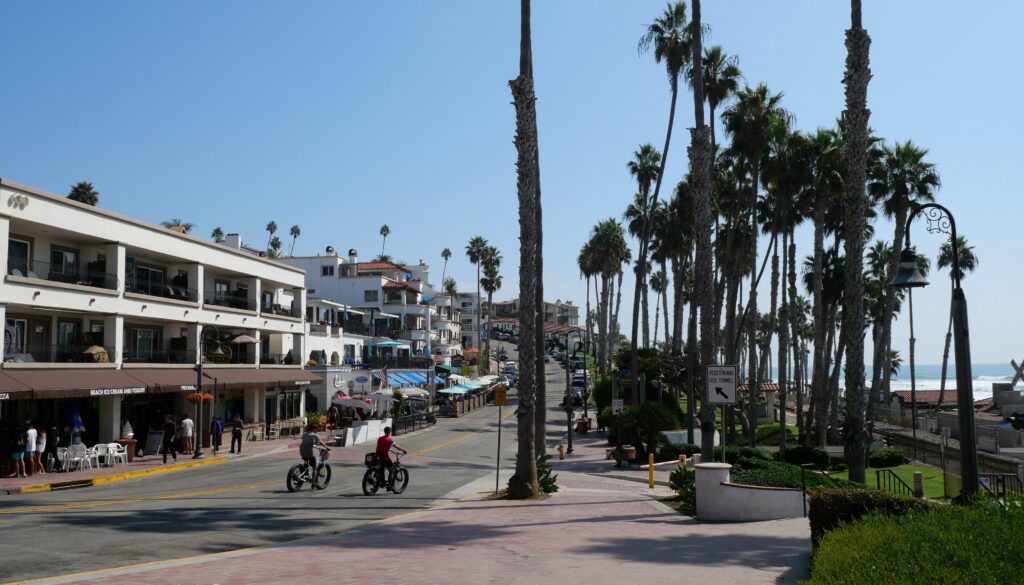
San Clemente is one of the more bike-friendly cities in Southern California, and the coastal trail system — running along the beach and continuing north toward Capistrano Beach and Dana Point — is a big part of daily life here, whether you’re commuting, exercising, or just enjoying the ride. It’s also a place where cyclists, e-bike riders, pedestrians, and cars regularly share space in ways that don’t always go smoothly. When a collision happens between a bicycle and a vehicle, one of the first questions that comes up — often from the cyclist themselves — is who actually had the right of way.
California law answers that question in more detail than most people realize, and the answer isn’t always what either party assumes. This post walks through what California law actually says about cyclist rights, where the trail’s specific crossing points create risk, and what to do if you’re involved in a collision while riding.
Cyclists Have the Same Rights as Drivers — With a Few Specific Rules
The starting point for California bicycle law is broader than most people expect: under the California Vehicle Code, a person riding a bicycle on a roadway has essentially the same rights and is subject to the same rules as the driver of a motor vehicle, except where a rule specifically can’t apply to a bike. That means a cyclist proceeding through a green light, or with the right of way at a four-way stop, has exactly as much legal standing as a car would in the same position.
From there, a handful of bicycle-specific rules layer on top of the general traffic rules, and these are the ones that tend to matter most when a collision happens.
- The “ride to the right” rule has real exceptions. Cyclists are generally required to ride as close as practicable to the right-hand edge of the road, but this rule comes with several built-in exceptions that matter in a crash analysis: when passing another cyclist or vehicle, when preparing for a left turn, when the lane is too narrow to safely share side-by-side with a car, and — importantly — when avoiding hazards like potholes, debris, parked cars, or a car door that’s just opened. A cyclist riding further from the curb than expected isn’t automatically in the wrong; it depends on why.
- Drivers passing a cyclist must change lanes when possible, not just give three feet. A 2022 update to California law (sometimes called the OmniBike Bill) tightened the passing rule: a driver overtaking a cyclist must move into an adjacent lane if one is available and it’s safe to do so — the same standard used when passing another car. The older three-foot minimum distance rule still applies, but only as a fallback when changing lanes isn’t possible, such as on a narrow two-lane road. In practice, this means a driver who squeezes past a cyclist within the same lane, even while leaving what feels like reasonable space, may be violating the law if a lane change was available.
- Bike lanes come with their own rules for both sides. Where a marked bike lane exists, a cyclist moving slower than surrounding traffic is generally required to use it, but is legally permitted to leave the lane to pass another cyclist, prepare for a left turn, avoid a hazard, or approach a right turn. Drivers, correspondingly, aren’t allowed to drive in a bike lane except briefly to enter or exit a driveway, parking space, or make a turn — and importantly, a driver executing a right turn across a bike lane is required to yield to a cyclist already in it. This is the legal basis for what’s often called a “right hook” collision: when a driver turns right into a cyclist’s path without yielding, the driver is typically the one who violated the law, even though the collision happens in what looks like the driver’s own lane of travel.
- Protected, physically separated trail sections work a little differently. Where a bikeway is separated from traffic by posts, curbs, or a physical barrier — as parts of the Coast Highway Protected Trail are — it’s technically no longer a “bike lane” under the standard definition, and a cyclist isn’t required to use it. This matters less for right-of-way in a collision and more for understanding that a cyclist riding on the adjacent roadway instead of the protected path, for whatever reason, hasn’t automatically done anything wrong.
E-Bikes: A Growing Source of Confusion
E-bikes have become extremely common on San Clemente’s beach trail, both among residents and visitors using rental fleets, and California law treats them somewhat differently depending on their classification. The state recognizes three classes based on top assisted speed and how the motor engages: Class 1 and Class 2 e-bikes are capped at 20 mph of motor assistance, while Class 3 e-bikes can assist up to 28 mph but come with additional restrictions, including a minimum age requirement and, in many cases, a helmet requirement regardless of the rider’s age.
For right-of-way purposes, e-bikes that meet these classifications are generally treated the same as traditional bicycles under the Vehicle Code — meaning the same passing, lane, and intersection rules apply. But the higher speeds involved, especially with Class 3 e-bikes, change the practical dynamics of a collision. A driver misjudging the closing speed of an e-bike moving at 25 mph, rather than a typical cyclist’s 12–15 mph, is a common contributing factor in trail-crossing collisions, and it’s worth both drivers and riders keeping in mind that an e-bike may be moving considerably faster than it appears.
Where the Beach Trail Creates the Most Risk
The trail’s design — much of it separated from vehicle traffic by barriers — makes it safer than riding directly in the roadway for long stretches. The risk concentrates at the points where the trail crosses driveways, parking lot entrances, and side streets, because these are the moments where a car’s path and a cyclist’s path intersect directly.
A few patterns show up repeatedly in these crossing-point collisions: a driver pulling out of a beachfront parking lot while looking left for a gap in car traffic, without checking for a cyclist approaching from the trail side; a driver turning right into a lot or driveway without yielding to a cyclist already crossing; and dooring incidents, where a parked car’s door opens directly into the path of a passing cyclist. California law addresses dooring directly — a person may not open a vehicle door on the side facing moving traffic unless it can be done safely and without interfering with traffic, which includes cyclists.
Familiar Crossing Points Along the Local Trail
A few spots along San Clemente’s beach trail system are worth knowing by name, since they’re where the trail’s protected sections give way to shared driveways, parking areas, or cross streets — exactly the transition points where car-versus-bike collisions concentrate. Near T-Street and the Pier Bowl, the trail intersects with beach parking areas that see constant vehicle turnover, especially in summer, meaning a steady stream of cars pulling in and out across the path. Further north, where the trail runs along North El Camino Real toward Linda Lane Park and Riviera Beach, several residential driveways and a handful of signed cross streets interrupt the protected section, requiring both cyclists and drivers to slow and check before proceeding. And where the trail approaches the Coast Highway Protected Trail segment connecting toward Capistrano Beach, the transition from a fully separated path to a more exposed shoulder-level section is a common point of driver confusion, since the level of separation — and therefore who has to yield to whom — changes within a short distance.
None of this means these areas are inherently more dangerous than any other, but recognizing that risk concentrates at transitions rather than along the open stretches of trail can help both drivers and cyclists know where to slow down and look twice.
What to Do If You’re Involved in a Bike-Vehicle Collision
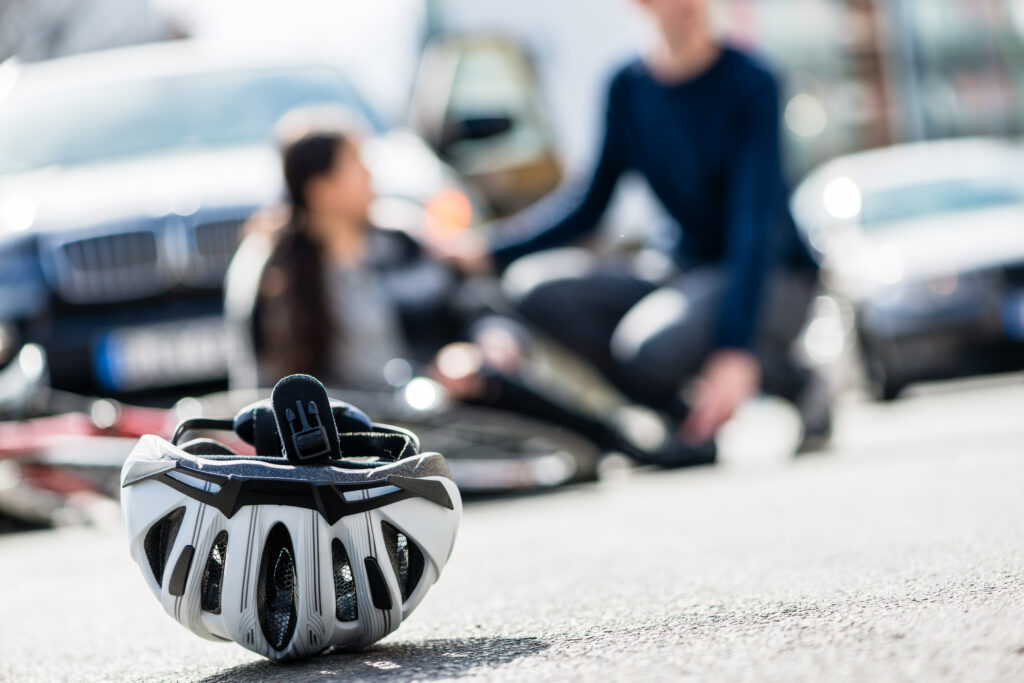
The immediate priorities are the same as any accident: get to safety if you can, call 911, and seek medical evaluation, even if you feel capable of continuing your ride. Cyclists absorb impact directly, without the protection of a vehicle frame, so injuries that feel minor in the adrenaline of the moment — particularly to the wrists, shoulders, or head — can turn out to be more serious than they initially seem.
A few additional steps matter specifically in bike collision cases:
- Don’t move your bike before documenting the scene, if it’s safe to leave it in place. The position of your bicycle relative to the vehicle, and any skid or scrape marks on the pavement, can help establish exactly how the collision occurred.
- Get the driver’s insurance information, even if the damage to your bike looks minor. Bicycle-versus-vehicle collisions often cause injuries that are disproportionate to the visible property damage, since a bike itself is far less protective than a car.
- Note whether you were within a marked bike lane, on the protected trail, or on the roadway, and why. Given how much of the legal analysis in these cases depends on lane position and the specific exception that applied at the time, an accurate account of exactly where you were and what you were doing — passing, turning, avoiding a hazard — is valuable early on, while it’s fresh.
- Understand that your own auto insurance may provide coverage, even though you weren’t in a car. This surprises a lot of people, but if you carry uninsured or underinsured motorist coverage on your own auto policy, it can often apply if you’re hit by a driver while riding a bicycle — not just while driving. It’s worth checking your policy or asking your insurer directly, since this coverage can matter significantly if the driver who hit you carries minimal insurance.
Helmets, Insurance, and a Common Misconception
One question that comes up often after a bicycle accident: does it matter that I wasn’t wearing a helmet? In California, only cyclists under 18 are legally required to wear a helmet, so an adult riding without one hasn’t violated the law simply by choosing not to. That said, the absence of a helmet can still come up in a claim if it affected the extent of a head injury, since California’s comparative negligence framework allows a defendant to argue that a plaintiff’s own choices contributed to the severity of their harm, separate from who caused the collision itself. It’s a nuance worth understanding rather than a reason to assume a claim is weakened — the two questions (who caused the crash, and whether an injury was made worse by a personal choice) are evaluated separately, and the first one usually carries far more weight than the second.
How Fault Gets Evaluated in Bike Collision Cases
Because cyclists are legally treated as drivers for most purposes, California’s comparative negligence rule applies here the same way it would in a car accident: fault can be divided between the cyclist and the driver based on each person’s actual conduct, and a cyclist found partially at fault can still recover compensation, reduced by their share of responsibility.
In practice, these cases often turn on a small number of very specific facts — whether a driver yielded before a right turn across a bike lane, whether a cyclist was legally permitted to be outside the bike lane at that moment, whether a car door was opened safely. Insurance companies handling bicycle claims sometimes start from an assumption that the cyclist was riding somewhere they “shouldn’t” have been, without accounting for the legal exceptions that often justify exactly that positioning. Understanding these rules — and being able to point to the specific provision that applied to your situation — often makes a meaningful difference in how a claim gets resolved.
Ride Safely, and Know Where You Stand
San Clemente’s trail system is one of the best things about living here, and the vast majority of rides happen without incident. But if you are involved in a collision while cycling, knowing that California law treats you as more than just an obstacle for drivers to avoid — with specific, enforceable rights — is worth understanding before you need it.
If you’ve been injured in a bicycle accident anywhere in San Clemente or Dana Point, Rosen Law Offices offers free consultations to help you understand your rights and options. Call us at (949) 335-0020.
This article is intended for general informational purposes and does not constitute legal advice. Every accident involves unique facts, and the outcome of any claim depends on the specific circumstances involved. If you’ve been injured, consult with a licensed attorney about your particular situation.