
Del Obispo Street is one of Dana Point’s busiest corridors, connecting Dana Point Harbor and the Town Center all the way through to Laguna Niguel and San Juan Capistrano, with access along the way to schools, retail centers, and the Del Obispo Street/Stonehill Drive intersection that regularly sees enough congestion that the cities of Dana Point and San Juan Capistrano have jointly funded improvement projects to address it. That kind of steady, stop-and-go corridor — school traffic, retail turns, signal after signal — is exactly the environment where distracted driving does the most damage, because it demands constant, active attention in a way that open highway driving simply doesn’t.

This post looks at what California law actually requires when it comes to phone use behind the wheel, why a corridor like Del Obispo Street amplifies the risk of distraction-related crashes, and how distracted driving gets proven in an injury claim.
What California Law Actually Prohibits
California’s distracted driving statutes are more specific than most people realize, and the details matter both for avoiding a ticket and for understanding how a distraction-related accident claim gets built.
- Vehicle Code Section 23123 prohibits driving while holding a phone to your ear. Drivers may only use a wireless phone in hands-free mode — meaning the device must be specifically configured for hands-free listening and talking, such as through a speakerphone or Bluetooth connection.
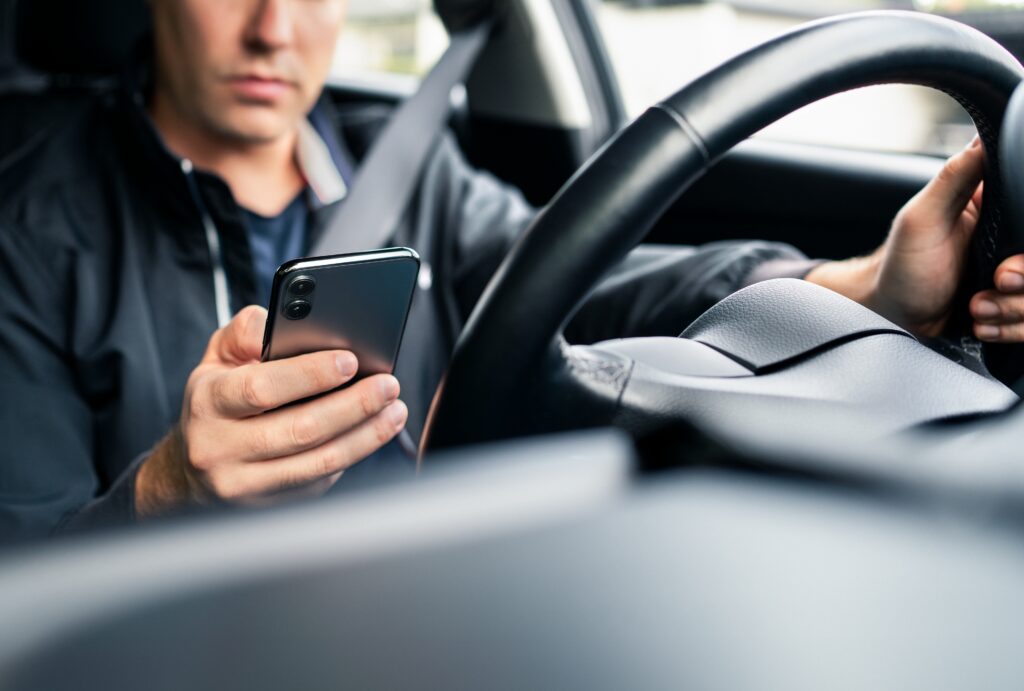
- Vehicle Code Section 23123.5 goes further, addressing the phone itself. This section prohibits driving while holding and operating a phone or other electronic wireless communication device, even for texting, browsing, or other functions beyond simply talking. The law does allow a driver to activate or deactivate a mounted device with a single tap or swipe — the classic example being tapping a navigation app once to start a route — but sustained interaction, like typing a text or scrolling, is prohibited regardless of whether the phone is mounted. California courts have specifically affirmed that merely holding a phone while driving, even without actively using it for communication, can violate this section.
- Drivers under 18 face a stricter standard. Vehicle Code Section 23124 bans any use of a wireless communication device by a driver under 18, even in hands-free mode, with narrow exceptions for contacting emergency services.
Why a Statutory Violation Matters More Than It Might Seem
In a typical negligence case, an injured person has to show that the other driver failed to act as a reasonably careful person would under the circumstances — a standard that can involve some genuine dispute about what a “reasonable” driver would have done. Distracted driving cases involving a phone are often more straightforward, because California recognizes a legal doctrine called negligence per se: when a driver violates a specific safety statute — like Vehicle Code 23123.5 — and that violation causes an accident, the violation itself can establish negligence without requiring a separate, independent showing of unreasonable conduct. In practice, this means that solid evidence of illegal phone use at the time of a crash can significantly strengthen an injury claim, shifting the analysis from “was this driver being careless” to “did this driver break a specific law that exists precisely to prevent this kind of accident.”
Why Corridors Like Del Obispo Street Are Especially Vulnerable
Distracted driving is dangerous everywhere, but certain kinds of roads amplify the consequences of even a brief lapse in attention. Del Obispo Street has several features that fit this pattern:
Frequent signals and turning movements demand continuous attention. A corridor connecting a harbor area, a town center, retail centers, and residential neighborhoods generates constant turning traffic — cars entering and exiting driveways, parking lots, and side streets. Each of these moments requires a driver to process movement from multiple directions, and a driver glancing at a phone for even two or three seconds can miss a car pulling out, a pedestrian stepping off a curb, or a light changing ahead.
School and community-facility traffic adds pedestrian and cyclist volume. With schools and family-oriented destinations along or near this corridor, the mix of road users includes more pedestrians and cyclists than a typical arterial road carries, particularly around drop-off and pickup times. A distracted driver’s reaction window shrinks considerably when the hazard is a person rather than another vehicle, since a person can change direction or step into the roadway with little warning.
Known congestion points create stop-and-go conditions where distraction feels “safer” but isn’t. It’s a common but mistaken belief that checking a phone during slow traffic or at a stoplight carries less risk than doing so at speed. In reality, congested, stop-and-go corridors are exactly where rear-end collisions cluster, because the driver behind a momentarily distracted driver often doesn’t realize traffic has stopped until it’s too late. A driver looking down for even a moment as traffic in front of them comes to a stop is a common and entirely preventable cause of low-speed but genuinely injurious collisions.
How Distracted Driving Gets Proven After a Crash
Unlike some forms of negligence, distraction isn’t always visible at the scene of an accident — a driver who was texting doesn’t look any different, in the moment, from one who simply failed to brake in time. Establishing that distraction caused a crash typically depends on a combination of the following:
Cell phone records. Phone carriers maintain records of calls, texts, and, in some cases, data usage that can be obtained through a formal request or subpoena, showing whether a driver’s phone was actively being used at the precise time of the collision.
Witness accounts. Passengers in either vehicle, pedestrians, or other drivers who observed a driver looking down at a phone, drifting within their lane, or failing to react to visible hazards can provide important corroborating testimony.
Vehicle event data. Many modern vehicles record data in the moments before a collision — speed, braking (or the absence of it), and steering input — through onboard systems sometimes referred to as “black box” data. A driver who never braked before a rear-end collision, despite having a clear view of stopped traffic ahead, is a pattern consistent with distraction.
Admissions at the scene or afterward. It’s not uncommon for a distracted driver to say something in the immediate aftermath of a crash — an apology referencing a phone, a text, or “I looked away for a second” — that becomes relevant evidence later, which is one more reason why documenting the scene and any statements made promptly matters.
Distraction Isn’t Limited to Phones
While phone use is the most heavily regulated form of distraction, and often the easiest to prove after the fact, California’s broader negligence standard covers any activity that pulls a driver’s attention away from the road — and a corridor like Del Obispo Street, with its steady stream of retail centers, restaurants, and drive-through locations, sees plenty of it. Eating or drinking while driving, programming a GPS system mid-drive rather than before starting out, reaching for something in the back seat, managing an unrestrained pet, or being distracted by children in the car are all common contributors to crashes on corridors like this one. None of these carry a specific statutory citation the way phone use does under CVC 23123.5, which means claims involving these other forms of distraction typically rely more heavily on witness testimony, vehicle event data, and the basic negligence standard — did the driver act as a reasonably careful person would have — rather than the negligence per se shortcut available in phone-related cases.
How Insurance Companies Handle Distracted Driving Claims
Distracted driving claims often draw more scrutiny from insurance adjusters than a standard rear-end collision claim, precisely because the underlying evidence — phone records, witness accounts of a driver’s behavior — can be more contested than physical evidence like skid marks or vehicle damage. It’s common for an at-fault driver’s insurer to dispute a distraction claim even when the circumstances strongly suggest it (a rear-end collision in clear, slow-moving traffic with no apparent reason for the driver not to have braked), simply because acknowledging distraction can mean acknowledging a stronger, negligence-per-se-based claim rather than an ordinary negligence dispute. This is one of the more common reasons a seemingly straightforward rear-end accident on a corridor like Del Obispo Street ends up taking longer to resolve than expected — the insurer is often quietly evaluating whether cell phone records or other evidence will surface before making a serious settlement offer.
When the Distracted Driver Is Working
Del Obispo Street carries a fair amount of commercial traffic — delivery vans, contractors, and rideshare or food delivery drivers moving between the harbor area, retail centers, and residential neighborhoods along the corridor. When a distracted driver causes an accident while working, an injured person’s claim isn’t necessarily limited to the driver’s personal insurance. Under a legal doctrine called respondeat superior, an employer can be held liable for an employee’s negligent driving if it occurred within the scope of their employment, which can mean a commercial policy with considerably higher limits than an individual driver would carry. This is worth keeping in mind if the vehicle that hit you displayed a company name or delivery branding — it’s a detail that can meaningfully change how a claim gets pursued.
Why Documentation Matters More in Distraction Cases Than Most
Because so much of a distracted driving claim depends on evidence that isn’t part of a standard police report — phone records, event data recorders, witness impressions of a driver’s behavior in the moments before impact — these cases reward early, thorough documentation more than most other types of accidents. A driver’s phone records, for example, are far easier to obtain and analyze in the weeks after an accident than months later, and witnesses who noticed a driver looking down or reacting late are more likely to remember specific, useful details if contacted promptly rather than after the memory has faded. If the circumstances of your accident suggest distraction may have played a role, treating that possibility as worth investigating from the outset, rather than waiting to see whether it becomes obvious later, tends to produce a stronger claim.
What to Do If You’re Hit by a Distracted Driver
- Note anything you observed about the other driver before or immediately after the crash. If you saw the driver looking down, holding a phone, or reacting late to stopped traffic, write it down as soon as possible while the memory is fresh.
- Ask any witnesses to stay or provide contact information. Along a busy corridor like Del Obispo Street, other drivers or pedestrians nearby may have seen something you didn’t, particularly if you were the one struck from behind.
- Preserve your own phone’s record of the incident. If you have a dashcam, or if your phone was mounted for navigation and might have relevant timestamps, don’t delete or overwrite this information before it can be reviewed.
- Don’t assume distraction will be obvious from the accident alone. Because a distraction-based claim often depends on records that aren’t part of the police report — phone records, vehicle data — it’s worth raising the possibility early with an attorney if the circumstances of the crash (a rear-end collision in slow-moving traffic, a driver who never braked, a driver who seemed to react late) suggest it, rather than assuming the standard police report will capture everything relevant.
A Preventable Cause, With Real Legal Consequences
Distracted driving remains one of the most common and most preventable causes of injury accidents in California, and busy local corridors like Del Obispo Street — with their frequent turns, mixed traffic, and stop-and-go conditions — are exactly where a moment’s inattention tends to matter most. California’s statutory framework gives injured victims a meaningful tool for holding a distracted driver accountable, but building that case well depends on gathering the right evidence quickly.
If you’ve been injured by a distracted driver in Dana Point or anywhere in South Orange County, Rosen Law Offices offers free consultations to help you understand your options. Call us at (949) 335-0020.
This article is intended for general informational purposes and does not constitute legal advice. Every accident involves unique facts, and the outcome of any claim depends on the specific circumstances involved. If you’ve been injured, consult with a licensed attorney about your particular situation.