
E-bikes have become a fixture of daily life in San Clemente — residents commuting along the beach trail, teenagers riding to school and the beach, visitors picking up rentals for the day. They’re convenient, increasingly affordable, and, in the case of Class 3 models, genuinely fast. What a lot of e-bike owners and riders don’t realize until something goes wrong is that the insurance picture around e-bikes is considerably murkier than it is for either a traditional bicycle or a car. This post focuses specifically on that insurance and liability gap — a topic distinct from the right-of-way rules covered in our post on cycling the San Clemente Beach Trail — and walks through what actually happens, coverage-wise, when an e-bike is involved in a collision, a theft, or a battery-related fire.
Why E-Bikes Fall Into a Legal Gray Zone
Under California law, a legally compliant e-bike — one that fits within the state’s three-class system, tops out at 750 watts, and retains operable pedals — is generally treated as a bicycle, not a motor vehicle, for traffic and right-of-way purposes. This isn’t just a general impression: California Vehicle Code Section 231, amended by Senate Bill 814 effective January 1, 2022, states plainly that “an electric bicycle is a bicycle.” The statute is unambiguous.
That clarity on the road doesn’t always carry over to insurance claims. Our firm has represented enough injured e-bike riders to see a recurring pattern: insurance adjusters — particularly on the homeowners and renters side — will point instead to CVC Section 415’s broader definition of a “motor vehicle” as “a vehicle that is self-propelled,” and argue that an e-bike fits that definition and falls under a policy’s motorized-vehicle exclusion. Since first-party insurance claims are governed by contract law, and Section 415’s definition is often incorporated into policy language, this becomes an argument about which statutory definition controls — CVC 231’s specific “an electric bicycle is a bicycle” language, or CVC 415’s broader “self-propelled vehicle” language.
In our experience, this position rarely survives sustained pushback once a claimant (or their attorney) points the adjuster back to Section 231 in writing. But it’s a real and recurring first move by insurers, and it’s worth knowing about before you’re the one navigating it.
Three Distinct Coverage Questions
It helps to separate e-bike insurance into three distinct scenarios, because the answer is different for each.
- Your e-bike is stolen or damaged. Whether a standard homeowners or renters policy covers the bike itself depends entirely on how that specific policy defines a motorized vehicle. Some insurers exclude e-bikes outright; others cover them under standard personal property limits, which may be far lower than the bike’s actual value — a real problem given that a quality e-bike commonly runs $2,000 to $8,000 or more. If your policy does provide some coverage, it’s still subject to your deductible and to your overall personal property limits, meaning a claim for a stolen e-bike could still leave you significantly out of pocket. The safest approach for a bike of meaningful value is to ask your insurer directly whether it’s covered, and if not, to add a scheduled personal property endorsement or a dedicated e-bike policy that lists the bike specifically and bypasses the motorized-vehicle exclusion.
- Your e-bike causes injury or property damage to someone else. This is the liability question — if you’re riding and you cause a collision that injures a pedestrian, another cyclist, or damages property, does your homeowners or renters liability coverage respond? Again, this depends on the motorized-vehicle exclusion in your specific policy. If your e-bike is excluded, you could be personally responsible for a judgment or settlement with no insurance behind you at all — a significant exposure that most riders don’t realize they’re carrying. Some insurers offer add-on liability endorsements specifically for e-bikes, and dedicated e-bike insurance policies typically include a liability component that fills this gap directly.
- You’re injured by someone else’s e-bike, or by a car while riding your own. If a car strikes you while you’re riding an e-bike, the driver’s auto liability insurance generally applies the same way it would to any other pedestrian or cyclist collision. It gets more complicated if the at-fault driver is uninsured or underinsured. Here, the CVC 231 definition actually works in the injured rider’s favor: since an electric bicycle is legally a bicycle, and California’s uninsured/underinsured motorist statute is designed to cover cyclists, pedestrians, and other non-motorists struck by a motor vehicle, UM/UIM coverage generally does extend to an e-bike rider hit by a car. Our firm’s experience representing injured e-bike riders bears this out — first-party UM/UIM coverage is typically extended once the carrier is reminded of Section 231 in writing, even in the cases where an adjuster’s initial response suggests otherwise. The friction tends to show up not in whether coverage applies at all, but in how much fault the carrier tries to assign to the rider — which is a separate fight, covered below.
Battery Fires: A Newer and Increasingly Important Risk
Lithium-ion battery fires have become a serious enough issue nationally that California enacted new battery safety requirements, tied to the UL 2849 safety certification standard, that took effect in 2026. Under the new framework, e-bike batteries sold in California generally need to meet this certification, and responsibility for battery safety is placed more clearly on manufacturers, importers, and sellers than it was before.
This matters for two separate reasons. First, from a pure safety standpoint, charging an e-bike with the manufacturer’s original charger, avoiding unattended overnight charging, and confirming your battery carries proper certification meaningfully reduces fire risk. Second, from a liability standpoint, the shift toward a clear certification requirement changes how battery fire claims get evaluated: a battery that lacks the required certification is now more straightforwardly arguable as a defective or “unreasonably dangerous” product under California law, which can support a product liability claim against the manufacturer, importer, or seller — separate from any insurance claim you might file for the fire damage itself.
If an e-bike battery fire damages your home, your homeowners policy’s dwelling coverage may apply to the structural damage, but insurers increasingly investigate whether the fire resulted from improper charging, an uncertified battery, or inadequate maintenance before honoring the claim — and insurers who pay out on a fire claim often pursue their own reimbursement claim (subrogation) against the battery or bike manufacturer if a defect is found. If you’re a renter, your personal liability coverage — again, subject to the motorized-vehicle exclusion question above — is typically your primary protection against a claim from your landlord or neighboring units if a fire spreads.
If Your Claim Is Denied, Get It in Writing
If an insurer tells you — often verbally, over the phone — that your e-bike claim is denied because the bike is a “motor vehicle,” you have a specific right worth knowing about. California insurance regulations require that a first-party claim denial be provided in writing, with a clear statement of the factual and legal basis for the denial, including any specific statute, policy provision, or exclusion the insurer is relying on (10 CCR § 2694.7(b)(1)). A verbal denial that never gets put in writing is much harder to challenge — and, in our experience, insurers are considerably less willing to commit a weak legal position (like treating a CVC 231-defined bicycle as an excluded motor vehicle) to paper once they know it will be scrutinized. If you’re told your e-bike claim is denied, ask directly for that explanation in writing, and reference Section 231’s language when you do.
A real example from our practice: We represented a cyclist — we’ll call him Paul — who was stopped at a red light in a left-turn lane on his e-bike. When the light turned green, Paul proceeded to turn left; the driver behind him went straight instead and struck the rear of Paul’s e-bike, throwing him onto the hood of the car. Despite clear evidence establishing that the driver had effectively rear-ended Paul, his own insurer initially assigned him 90% of the fault for the crash, based in part on a poorly written police report, and used that determination to try to leverage a low settlement on his underinsured motorist claim. After sustained written pressure — and after the adjuster put the carrier’s reasoning in writing, revealing how thin it was — we were able to resolve Paul’s UM claim for full policy limits. The lesson generalizes well beyond this one case: an initial fault determination from your own insurer isn’t final, and pushing for everything in writing is often what changes the outcome.
The Liability Fight: Expect Comparative Fault to Come Up
Even once coverage questions are resolved, most e-bike claims involve some dispute over comparative fault — California’s rule that fault can be divided between parties, with compensation reduced accordingly. In our experience, insurers handling cycling and e-bike claims tend to reach for fault arguments almost reflexively: a rider in an intersection “shouldn’t have been there,” a rider in a bike lane was “going too fast,” and so on, regardless of how clear the underlying liability actually is. This isn’t unique to e-bikes, but the newer and less-understood status of e-bikes tends to give adjusters more room to make these arguments sound plausible to a rider who doesn’t know the relevant Vehicle Code sections. Keeping a clear, written record of exactly where you were riding and why — including any of the standard bike-lane exceptions discussed in our post on cycling the beach trail — puts you in a stronger position if an insurer tries to shift blame your way after the coverage question is settled.
Rental E-Bikes: A Different Liability Picture Entirely
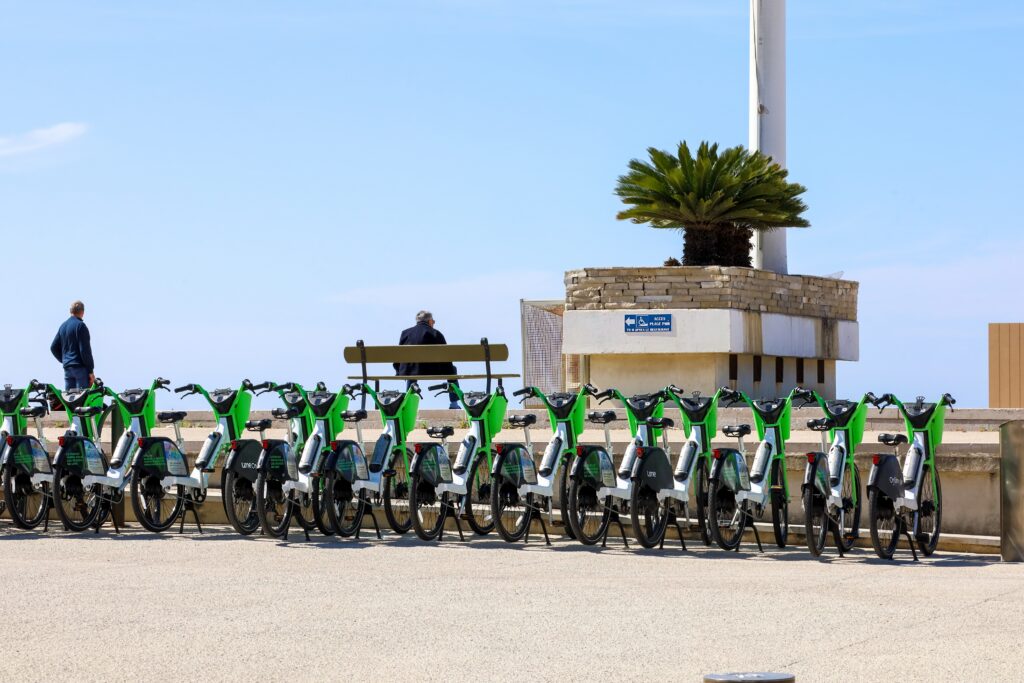
San Clemente sees a steady stream of rental e-bike use, particularly during the summer. Rental agreements typically include liability waivers that riders sign, often without much scrutiny, before heading out. It’s worth knowing that these waivers aren’t absolute — California law limits the enforceability of liability waivers in cases involving gross negligence, meaning a rental company that provided a bike with a known mechanical defect, or that failed to perform basic safety maintenance, may still bear responsibility despite a signed waiver. That said, a standard waiver covering ordinary risks of riding is generally enforceable, which makes documentation particularly important if a rental e-bike malfunctions or causes an accident — photos of the bike’s condition, any warning lights or issues you noticed before the incident, and prompt reporting to the rental company can all matter if a waiver’s limits become a point of dispute.
E-Bikes, Minors, and Parental Liability
E-bikes are extremely popular among teenagers in San Clemente, and California law places specific age restrictions on the faster Class 3 category: riders must be at least 16 to operate a Class 3 e-bike, and helmet use is required for minors on any class of e-bike. When a minor is injured — or causes injury to someone else — while riding an e-bike, a few additional legal questions come into play beyond the standard insurance and liability analysis above. A parent who purchases or allows a child to ride an e-bike that doesn’t meet legal requirements for that child’s age, or who fails to reasonably supervise a known risk (for example, letting a young teenager ride a modified, overpowered e-bike with the speed limiter removed), can face a claim for negligent entrustment if that decision contributes to an accident. This is a separate legal theory from the child’s own conduct, and it’s worth understanding if you’re a parent making decisions about what kind of e-bike is appropriate for your child.
Mechanical Failure and Product Liability
Not every e-bike accident traces back to a rider’s or driver’s conduct. Brake failure, throttle malfunctions, and sudden power surges have all been documented causes of e-bike accidents, particularly with lower-cost or improperly maintained models. When a mechanical defect — rather than rider error — causes a crash, California’s product liability laws may allow an injured person to pursue a claim directly against the bike’s manufacturer, importer, or seller, separate from any insurance-based claim. Unlike a standard negligence claim, product liability in California can apply under a strict liability standard for a defective product, meaning an injured person doesn’t necessarily need to prove the manufacturer was careless — only that the product had a defect that made it unreasonably dangerous, and that the defect caused the injury. If you experience an unexplained mechanical failure on an e-bike, preserving the bike itself, rather than having it repaired or discarded, can be important evidence if a defect is later suspected.
What About E-Scooters?
Rental and personal e-scooters raise a similar but distinct set of questions from e-bikes, since California treats them under a somewhat different set of rules (motorized scooters have their own Vehicle Code provisions separate from the e-bike classification system), and insurance policies often address them differently as well. If you ride or rent e-scooters in addition to or instead of an e-bike, it’s worth asking your insurer the same direct questions about coverage — don’t assume that an answer about e-bike coverage automatically extends to a scooter, since insurers sometimes draw the line between the two differently than state traffic law does.
Practical Steps for E-Bike Owners and Riders
- Ask your insurer directly whether your e-bike is covered, rather than assuming. The motorized-vehicle exclusion issue is common enough, and varies enough between insurers, that it’s worth a direct conversation rather than an assumption based on how you think the bike should be classified.
- Consider a dedicated e-bike policy for higher-value bikes. Given the gaps in standard homeowners and renters coverage, a standalone e-bike insurance policy — covering theft, damage, and liability specifically — is often the more reliable option for anyone riding a bike worth several thousand dollars.
- Verify your battery’s certification and charge it properly. Beyond the safety benefits, proper charging practices and certified batteries put you in a stronger position if a fire-related claim or dispute ever arises.
- If you’re hit while riding, document the driver’s insurance information the same way you would in any collision. The driver’s liability coverage is usually your first and most straightforward path to compensation, regardless of the more complicated questions around your own coverage.
- Check your auto policy’s UM/UIM language if you ride an e-bike regularly — and know your rights if a carrier pushes back. CVC 231 supports coverage for e-bike riders under most UM/UIM policies, but if an adjuster initially resists, ask for a written explanation and cite Section 231 directly.
Why This Matters More Each Year
E-bike adoption in San Clemente has grown quickly, and insurance products, state regulations, and court decisions are all still working to catch up to how these bikes are actually being used. That lag means real gaps exist right now — gaps that a bike owner or rider generally only discovers at the worst possible moment, after a theft, a collision, or a fire has already happened. Taking the time to understand your specific coverage now, before you need it, is genuinely one of the more valuable things an e-bike owner in this area can do.
A Rapidly Evolving Area of the Law
E-bike insurance and liability law is genuinely still catching up to how widely these bikes are now used, and California’s 2026 battery safety requirements are a sign that regulators are actively working to close some of these gaps. In the meantime, understanding exactly where your own coverage does and doesn’t apply — before an accident, theft, or fire forces the question — is the best protection available.
If you’ve been injured in an e-bike accident, or you’re dealing with an insurance dispute involving an e-bike collision, theft, or fire, Rosen Law Offices offers free consultations to help you understand your options. Call us at (949) 335-0020.
This article is intended for general informational purposes and does not constitute legal advice. Every accident involves unique facts, and the outcome of any claim depends on the specific circumstances involved. If you’ve been injured, consult with a licensed attorney about your particular situation.