
A motorcycle gives a rider almost nothing between their body and the road. There is no steel cage, no airbag, no crumple zone, and no seat belt, and when a crash happens the rider’s own body absorbs the forces that a car’s structure would otherwise handle. That simple fact shapes everything about a motorcycle injury claim: the kinds of injuries that occur, how long recovery takes, how much it costs, and why these cases so often involve numbers that surprise people.
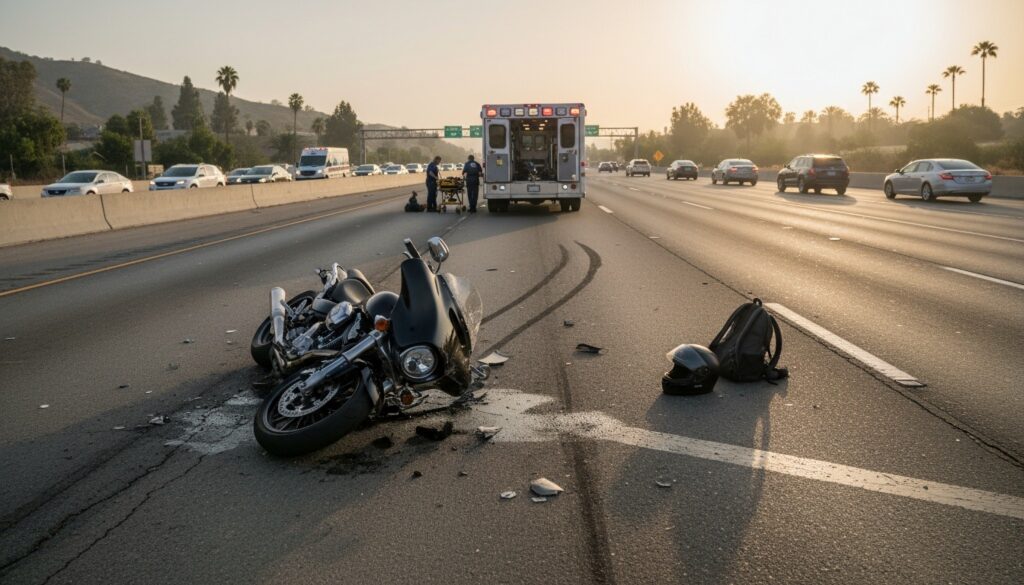
South Orange County is motorcycle country. Riders commute on I-5, cruise the coast road through San Clemente and Dana Point, and head inland to the canyon roads we covered in our post on the Ortega Highway. Most rides end uneventfully. When one doesn’t, the injuries tend to be serious, and the financial consequences can last far longer than the physical healing. This post explains the injuries we see most often, how the costs build up over time, and why it matters to understand the full picture before agreeing to settle any claim.
The Injuries Riders Commonly Suffer
Motorcycle injuries are rarely a single problem. A rider thrown from a bike often has several injuries at once, and each one comes with its own treatment path.
- Road rash and skin injuries. Sliding across pavement can remove layers of skin, sometimes down to muscle or bone. Severe road rash can require skin grafts, repeated wound care, and treatment for infection, and it often leaves permanent scarring. Protective gear reduces this risk considerably, which is one reason riders and their families should preserve the jacket, pants, and gloves worn during a crash as evidence.
- Fractures. Legs and feet are frequently trapped or crushed between the bike and another vehicle or the ground. Wrists, collarbones, ribs, and pelvis fractures are also common. Some heal with casting and time. Others require surgery with plates, rods, or screws, and complicated breaks can lead to lasting mobility problems, chronic pain, or later joint replacement.
- Traumatic brain injuries. A helmet dramatically lowers the risk of fatal head injury, but it does not eliminate concussion or more serious brain trauma. As we discuss in our post on delayed-onset brain injury symptoms, some of these injuries are not obvious at the scene and can emerge or worsen over days.
- Spinal injuries. Spinal fractures and cord injuries can result from the sudden forces of a crash, and they carry some of the highest lifetime costs of any injury type. We cover those separately in our post on spinal cord injuries and long-term care planning.
- Internal injuries. Blunt trauma can damage the spleen, liver, lungs, or kidneys. Internal bleeding may not be visible from the outside, which is one reason emergency evaluation matters even when a rider feels able to walk away.
- Amputations and limb loss. Crush injuries, particularly to the legs and feet, sometimes lead to surgical amputation, either at the scene of care or after failed attempts to save the limb. Prosthetics, fittings, replacements over a lifetime, and rehabilitation become permanent costs.
The Helmet Law and What It Does and Doesn’t Mean for a Claim
California requires every motorcycle rider and passenger to wear a helmet that meets federal safety standards (Vehicle Code Section 27803). Riders who wear compliant helmets are complying with the law, and that compliance helps in a claim by removing an argument the other side would otherwise make.
If a rider wasn’t wearing a helmet, the effect on a claim is more nuanced than many people assume. Not wearing a helmet does not shift responsibility for causing the crash. A driver who turns left across a rider’s path is at fault for that turn whether or not the rider had a helmet on. What a missing helmet can do is give the defense an argument about the severity of a head injury, essentially claiming that some portion of the harm would have been avoided with proper protection. That argument goes to how much the injury is worth, not to who caused the collision, and it is evaluated on the specific medical evidence.
Where the Money Goes: The Cost Categories
The cost of a serious motorcycle injury is easy to underestimate, because the bills that arrive first are only the beginning. It helps to think about costs in layers.
- Emergency and acute care. Ambulance or air transport, trauma evaluation, imaging, emergency surgery, and intensive care are typically the first and most concentrated expenses. A single surgical hospitalization can produce bills in the hundreds of thousands of dollars.
- Rehabilitation. Physical therapy, occupational therapy, and sometimes inpatient rehabilitation follow serious injuries. This phase can last months, and its cost is often underestimated because it happens after the drama of the hospital stay has ended.
- Follow-up procedures. Hardware removal, revision surgeries, reconstruction, and treatment of complications are common after severe fractures and burns or road-rash injuries. Some of these procedures are foreseeable at the time of the initial claim; others only become apparent months later.
- Lost income. Time away from work is an obvious loss. Less obvious is diminished earning capacity, meaning the loss that occurs when a rider can no longer do the same kind of work at the same level, or must retire earlier than planned. For a tradesperson, a first responder, or anyone whose work is physical, a lasting injury can change an entire career trajectory.
- Future medical care. Chronic pain management, injections, future surgeries, assistive devices, home modifications, and attendant care are real expenses that recur over years or decades. Estimating them properly usually requires input from treating physicians and, in significant cases, a life care planner and an economist who can translate a care plan into present-day dollars.
- Non-economic losses. These are the human losses that don’t come with a receipt: physical pain, the loss of the ability to ride or enjoy other activities, scarring and disfigurement, emotional distress, and the strain on family relationships. They are a legitimate and often substantial part of the value of a serious injury claim.
How Past Medical Bills Are Valued
One technical point that affects motorcycle claims, like most injury claims, is how past medical expenses are measured. Under the California Supreme Court’s decision in Howell v. Hamilton Meats & Provisions, Inc. (2011), a plaintiff generally can’t recover the full billed amount of medical care that was paid at a lower negotiated rate by health insurance; recovery is limited to the amounts actually paid or incurred. Later decisions have addressed situations where an injured person treats outside of insurance on a lien basis. We cover this in more depth in our post on medical bills and liens after an accident. The point for riders is that how you obtain treatment, and how it is billed and paid, can affect how the medical portion of a claim is calculated, which is one more reason to keep every bill, statement, and explanation of benefits.
The Insurance Problem: Why Limits Matter More for Riders
Riders are more likely than most accident victims to be injured badly enough that the other driver’s insurance runs out before their damages do. California’s minimum liability limits rose to $30,000 per person and $60,000 per accident (with $15,000 for property damage) in 2025, but a serious motorcycle injury can generate medical bills alone that dwarf those limits. That reality makes two things especially important.
Your own coverage. Uninsured and underinsured motorist coverage on a rider’s own policy can be the difference between a workable recovery and a shortfall, and we explain how it works in our post on that subject. Medical payments coverage, if your policy includes it, can help with early bills regardless of fault. A rider who insures the motorcycle should check that the policy actually includes UM/UIM coverage and at what limits, since motorcycle policies are sometimes written more minimally than auto policies.
Identifying every source of recovery. In a serious crash, there may be more than one responsible party or more than one applicable policy: a commercial vehicle’s coverage, an employer’s policy if the other driver was working, a rideshare company’s coverage, or a government entity if a road defect contributed. Finding these sources early is part of building a claim that reflects the true size of the loss.
Overcoming Bias Against Riders
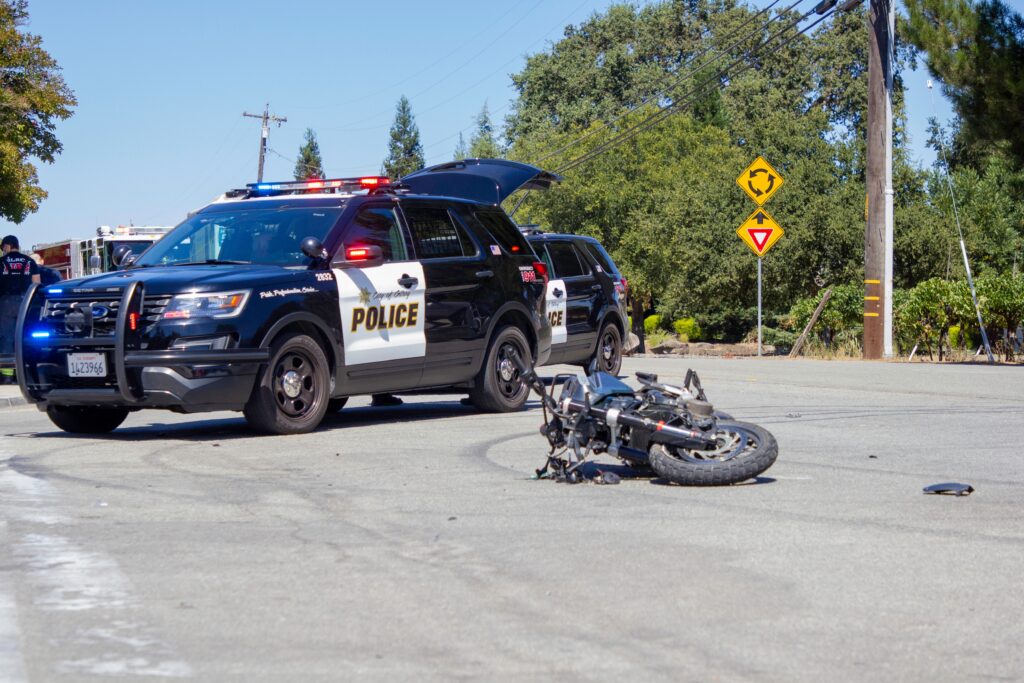
Motorcyclists face a stubborn assumption from some insurers, and occasionally from jurors: that riders are reckless and therefore at least partly to blame when they’re hurt. That assumption is often applied without regard to the facts. A rider stopped at a light who is rear-ended, or a rider traveling at a lawful speed who is hit by a driver making an unsafe left turn, did nothing to cause the crash. California’s pure comparative negligence rule means a rider found partly at fault can still recover, reduced by their share, but a claim built on stereotype rather than evidence should be challenged directly. As we explained in our post on lane splitting, even lawful riding practices don’t make a rider negligent by default.
What to Do After a Motorcycle Crash
- Get medical care right away, even if you feel capable of standing. Adrenaline masks pain, and internal and head injuries can be silent early on. Tell providers everything that hurts, however minor it seems.
- Preserve your gear and the motorcycle. Your helmet, jacket, gloves, boots, and the bike itself are evidence. Damage patterns can show speed, angle, and points of impact. Don’t repair or dispose of the motorcycle before it has been documented.
- Document the scene. Photograph the road, skid marks, debris, signage, and vehicle positions when you safely can, and get witness contact information. Note whether any nearby business or traffic camera may have footage, and act quickly because video is often overwritten.
- Be careful with early insurance contacts. As we discuss in our post on insurance adjusters, avoid recorded statements to the other driver’s insurer while you’re still injured and still learning the extent of the damage.
- Keep a running record of the impact on your life. Missed work, canceled activities, pain levels, and limitations are easy to forget and useful to have documented in real time.
- Don’t rush to settle. Early offers tend to arrive before the full medical picture is known. We explain why this matters in our post on first settlement offers.
Recovery Timelines and Maximum Medical Improvement
Serious motorcycle injuries rarely follow a tidy schedule. Doctors use the term maximum medical improvement to describe the point at which a patient’s condition has stabilized and further significant recovery isn’t expected. It doesn’t necessarily mean the person has returned to how they were before, only that they aren’t likely to get much better. Until a rider reaches that point, it is difficult, and often premature, to say what their permanent limitations will be or what future treatment they’ll need. A rider with a fractured femur might be walking without assistance in several months, or might face a second surgery a year later if the bone doesn’t heal properly. A rider with a nerve injury in the arm may not know for many months how much function will return.
This matters in a claim because the value of a case depends on the full course of recovery, not just the early stages. It is one reason we caution against settling before the medical picture is clear, and why the timing of a settlement, discussed in our post on first offers, can matter as much as its amount.
When Experts Become Part of the Case
In serious motorcycle cases, the claim is often supported by more than medical records. An accident reconstruction specialist can analyze skid marks, vehicle damage, and speed to show how a crash happened, which is often crucial where a driver claims not to have seen the rider. A human-factors expert can address whether a driver reasonably should have noticed a motorcycle, whose narrow front profile can make it harder for other drivers to perceive, a fact that lies behind the familiar “I never saw him” explanation. Treating physicians and independent medical experts explain the injuries and the care they will require, and vocational and economic experts quantify lost earning capacity and future costs. The other side will bring experts of its own, so a well-prepared claim anticipates that contest from the beginning rather than reacting to it later.
Understanding the Whole Picture Before You Decide
A motorcycle crash can change a person’s health, finances, and future plans all at once. The most common mistake we see is treating an early offer as if it reflects the full cost of what happened, when the true cost, particularly of future care and lost earning capacity, may not be clear for months or years.
If you or a family member has been injured in a motorcycle crash anywhere in San Clemente, Dana Point, or South Orange County, Rosen Law Offices offers free consultations to help you understand your options and the full scope of what your claim may involve. Call us at (949) 335-0020.
This article is intended for general informational purposes and does not constitute legal advice. Every accident involves unique facts, and the outcome of any claim depends on the specific circumstances involved. If you’ve been injured, consult with a licensed attorney about your particular situation. Rosen Law Offices, APC is here for a free consultation. Call us at 949-335-0020.