
If you live in San Clemente, you already know that our stretch of coastline is one of the prettiest drives in Southern California — and one of the most deceptive. The same curves, ocean views, and beach access points that make North and South El Camino Real (our local name for the old Pacific Coast Highway) so pleasant to drive are exactly what make it dangerous. Add in seasonal tourist traffic, cyclists on the Coast Highway Protected Trail, pedestrians crossing to the sand, and the tight merge points where the highway meets Interstate 5, and you have a road system that keeps South Orange County personal injury attorneys busy year-round.
This post breaks down the specific stretches of road in and around San Clemente where crashes happen most often, why they happen, and what to do if you find yourself dealing with an accident in one of these areas. Whether you’re a lifelong local or a newer resident still learning the rhythms of this town, understanding these risk points can help you drive, walk, and ride more defensively — and know your options if the worst happens.

Why San Clemente’s Coast Road Is Different From a Typical City Street
Most people associate “Pacific Coast Highway” with the postcard version — Malibu, Laguna Beach, the open road along the water. In San Clemente, the roadway that carries that same coastal traffic is officially North and South El Camino Real, a former segment of old Highway 101 that predates the modern I-5 freeway. It runs close to the bluffs, weaves through residential neighborhoods, and connects directly to some of the city’s most popular beach access points, including the pier, T-Street, and the trail system that continues north toward Capistrano Beach and Dana Point.
That combination creates a road environment unlike a typical arterial street. Drivers are often unfamiliar with the area and distracted by ocean views. Beachgoers cross mid-block instead of at signals. Surfers carry boards across traffic lanes. Cyclists share narrow sections of pavement with cars moving at speed. And because the road hugs an unstable coastal bluff in places, it has a documented history of landslides and emergency closures that suddenly reroute traffic onto side streets never designed for the volume.
None of this means the road is unsafe to use — thousands of people drive, bike, and walk it every day without incident. But knowing where the specific risk points are can make a real difference in how you approach them.
The Highest-Risk Areas in and Around San Clemente
North and South El Camino Real (the Old Coast Highway)
The core of the coast road through San Clemente presents a few recurring hazards. Several sections narrow to accommodate the terrain, leaving little shoulder for a driver to react if a vehicle ahead brakes suddenly or a pedestrian steps into the road. Sharp curves near the bluffs limit sight lines, so a driver going the speed limit can still find themselves with very little time to respond to a stopped car, a cyclist, or a jaywalker.
Adding to the complexity, this corridor also carries a section of the Coast Highway Protected Trail, a paved path used by cyclists and pedestrians that runs alongside the roadway between Capistrano Beach and North Beach. While parts of the trail are separated from traffic by concrete barriers, other sections are not, and the points where the trail crosses driveways, side streets, and parking lot entrances are where car-versus-cyclist and car-versus-pedestrian collisions are most likely to occur. Drivers turning into or out of beachfront parking areas frequently aren’t looking for a cyclist moving at 15–20 mph along the trail, and that gap in attention is a common cause of “right hook” and dooring-style accidents.
This stretch of road has also experienced periodic emergency closures due to bluff instability and landslides, sometimes shutting down both directions for extended periods. When that happens, traffic is rerouted onto residential streets like Avenida Pico or Camino Capistrano that weren’t built to handle highway-level volume. These detour periods tend to see an uptick in fender-benders and near-misses simply because unfamiliar drivers are navigating unfamiliar intersections under time pressure.
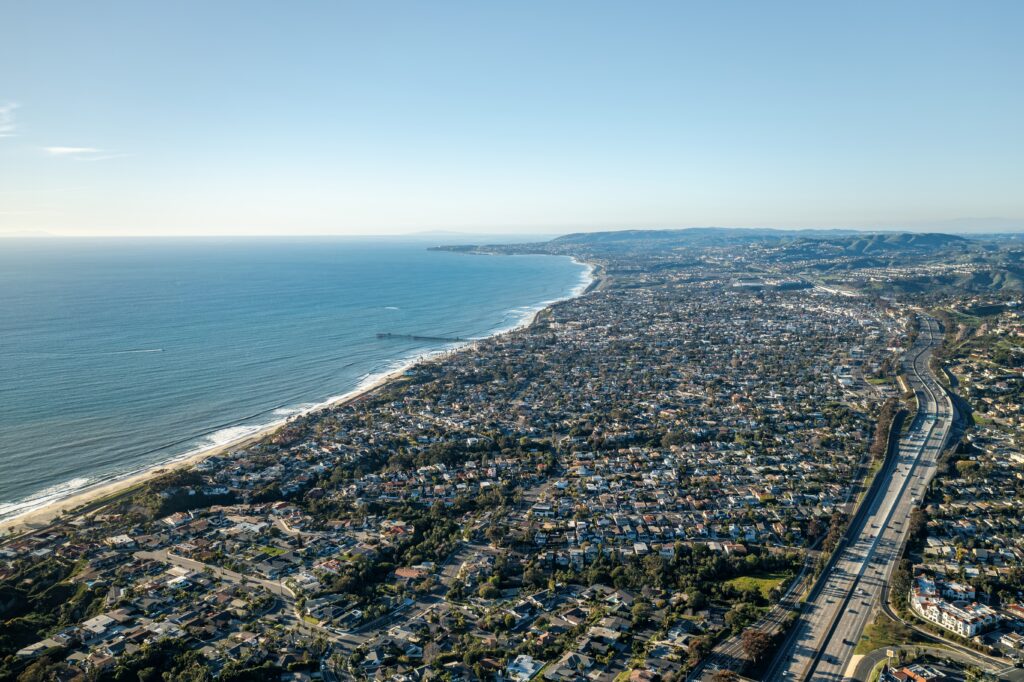
Avenida Pico and the I-5 Interchange
Avenida Pico is one of the busiest connector streets in San Clemente, linking the coast road to Interstate 5, the outlet mall, and several neighborhoods on the inland side of town. The interchange itself sees a constant mix of local commuters, freeway traffic exiting for shopping or the beach, and out-of-town visitors unfamiliar with the merge pattern. That mix is a recipe for rear-end collisions in slow-moving traffic, side-impact crashes from drivers misjudging gaps, and merging accidents where a driver entering or exiting the freeway fails to match the speed of traffic already in the lane.
Because this interchange also functions as a primary detour route whenever the coast road is closed, congestion here can spike quickly and without warning — which is worth keeping in mind if you regularly commute through the area.
Camino de Estrella
This residential connector road links the coastal part of San Clemente to the inland neighborhoods and includes stretches with hills and limited visibility around curves. It’s a common route for local traffic trying to avoid I-5 backups, which means it often carries more volume — and more impatient driving — than its design was intended for. Loss-of-control accidents and head-on collisions are more common here than on a typical residential street, particularly after dark or during wet weather, when the curves become harder to judge.
Cristianitos Road and the Southern I-5 On-Ramps
Cristianitos Road provides access to some of the area’s most popular recreational spots, including trailheads and beach areas near the San Clemente/San Onofre border. Because it draws a steady mix of local residents and out-of-town visitors headed to the beach or trails, drivers here range widely in their familiarity with the road. The merge lanes onto I-5 in this area are relatively short, which leaves little room for error — a driver who hesitates or misjudges the gap in freeway traffic can quickly find themselves in a dangerous merging situation.
El Camino Real Near the San Clemente Outlets
The commercial stretch of El Camino Real near the outlet shopping center sees frequent low-speed collisions and pedestrian near-misses. Shoppers crossing mid-block, cars backing out of angled parking, and drivers distracted while looking for an open spot all combine to make this a higher-risk area, especially during weekends and the holiday shopping season.
Why Summer and Weekends Change the Equation
San Clemente’s year-round population is relatively modest, but the city’s beaches, pier, and surf breaks draw significantly more visitors during the summer months and on weekends throughout the year. That seasonal and weekly surge changes the character of local traffic in a few important ways.
First, there are simply more cars on the road, which increases congestion on routes that already struggle with capacity, particularly the coast road and the Avenida Pico interchange. Second, a larger share of drivers are visitors — people unfamiliar with San Clemente’s specific quirks, like where pedestrians tend to cross outside of marked crosswalks, or which turn lanes back up during peak beach hours. Third, pedestrian and cyclist volume rises sharply near the beach access points, increasing the odds of a car-versus-person incident precisely in the areas where sightlines are already limited by curves and parked cars.
None of this is a reason to avoid the coast road — it’s simply useful context. Extra caution during summer afternoons, weekend mornings, and any stretch of warm weather is a reasonable habit for anyone who regularly drives, bikes, or walks through these corridors.
What to Do If You’re Involved in an Accident in One of These Areas
The steps that protect your health and your legal options are largely the same no matter where in San Clemente an accident happens, but a few of them matter more in areas with heavy pedestrian and cyclist traffic or unpredictable road closures.
- Check for injuries and move to safety if possible. On narrow stretches of the coast road, staying in a live traffic lane after a collision is itself dangerous. If your vehicle is drivable and it’s safe to do so, move to a parking area or side street before exchanging information.
- Call 911, even for a seemingly minor crash. A police report creates an official record of what happened, which matters more than people often expect once an insurance claim is underway. It’s especially important in pedestrian or cyclist collisions, where the injured party may not immediately realize the extent of their injuries.
- Photograph everything, including the surrounding area. Because so many of San Clemente’s higher-risk spots involve specific road features — a blind curve, a beach access crossing, a merge lane — photos of the road itself, not just the vehicles, can be important later. If a landslide-related closure or detour contributed to the circumstances, note that too.
- Get contact information from any witnesses. Beach-adjacent areas tend to have more foot traffic than a typical accident scene, and a witness who saw a pedestrian dart into the road, or a driver run a stop sign, can make a meaningful difference in how liability gets sorted out.
- Seek medical attention, even if you feel fine. Adrenaline can mask pain from soft-tissue injuries for hours or days. This is true for drivers, but it’s especially true for cyclists and pedestrians, who often absorb the full force of an impact directly.
- Be cautious about early conversations with insurance adjusters. It’s common for an insurance company to reach out quickly after a crash, sometimes within a day or two. Recorded statements given before you’ve seen a doctor or fully understood your injuries can end up limiting your claim later.
How California Law Applies to These Accidents
A few legal principles come up often in San Clemente crash cases, and it’s worth understanding them even before you need them.
California follows a pure comparative negligence rule, which means that even if you were partly at fault for an accident, you can still recover compensation — it’s simply reduced by your percentage of fault. This matters a great deal in cases involving pedestrians or cyclists on the coast road, where insurance companies sometimes try to argue that a pedestrian who wasn’t in a marked crosswalk, or a cyclist who was riding outside a protected section of the trail, bears significant responsibility. Whether that argument holds up often depends on the specific facts of the road, sightlines, and signage at that exact location — which is part of why documenting the scene matters so much.
Personal injury claims in California are also subject to a statute of limitations, generally two years from the date of the injury for claims involving bodily harm. That may sound like a long time, but evidence tends to disappear quickly — skid marks fade, witnesses move, and surveillance footage from nearby businesses is often overwritten within days or weeks. Acting sooner rather than later, even if you’re unsure whether you want to pursue a claim, tends to preserve more options.
Finally, given how much of San Clemente’s coastal traffic includes visitors and out-of-town drivers, uninsured and underinsured motorist coverage is worth a second look if you haven’t checked your own policy recently. If you’re hit by a driver with minimal or no insurance, this coverage — which many people don’t realize they have, or don’t have enough of — can be the difference between a fair recovery and a frustrating financial gap.
A Local Perspective Matters
Every one of the areas described above has its own personality: the tight curves and bluff instability along the coast road, the merge pressure at Avenida Pico and I-5, the hills on Camino de Estrella, the short on-ramps near Cristianitos. Understanding those specifics isn’t just useful for avoiding a crash — it’s useful afterward, too, when the question of fault often comes down to details about the exact road, sightline, or signage at the scene.
If you’ve been injured in an accident anywhere along San Clemente’s coast road or the surrounding streets, Rosen Law Offices is based right here in town, and we know these roads well. We offer free consultations to help you understand your options, whether that means dealing with an insurance company, gathering the right evidence, or simply getting a clear answer about whether pursuing a claim makes sense for your situation. Call us at (949) 335-0020 to talk through what happened and figure out the best next step.
This article is intended for general informational purposes and does not constitute legal advice. Every accident involves unique facts, and the outcome of any claim depends on the specific circumstances involved. If you’ve been injured, consult with a licensed attorney at Rosen Law Offices, APC about your particular situation.