
Few spots capture what San Clemente is about better than the Pier and the Pier Bowl area around it — surfers carrying boards across the street at dawn, families walking down to the sand with beach chairs and coolers, the Thursday night crowds spilling out after a summer concert, visitors wandering between the shops on Avenida Del Mar and the water. It’s also one of the highest foot-traffic areas in the city, where pedestrians, cars, cyclists, and skateboarders all compete for the same limited space. Understanding exactly what legal protections you have as a pedestrian here — and what obligations you carry in return — matters both for staying safe and for knowing where you stand if you’re ever involved in an accident.
The Basic Rule: You Have the Right-of-Way More Often Than You’d Think
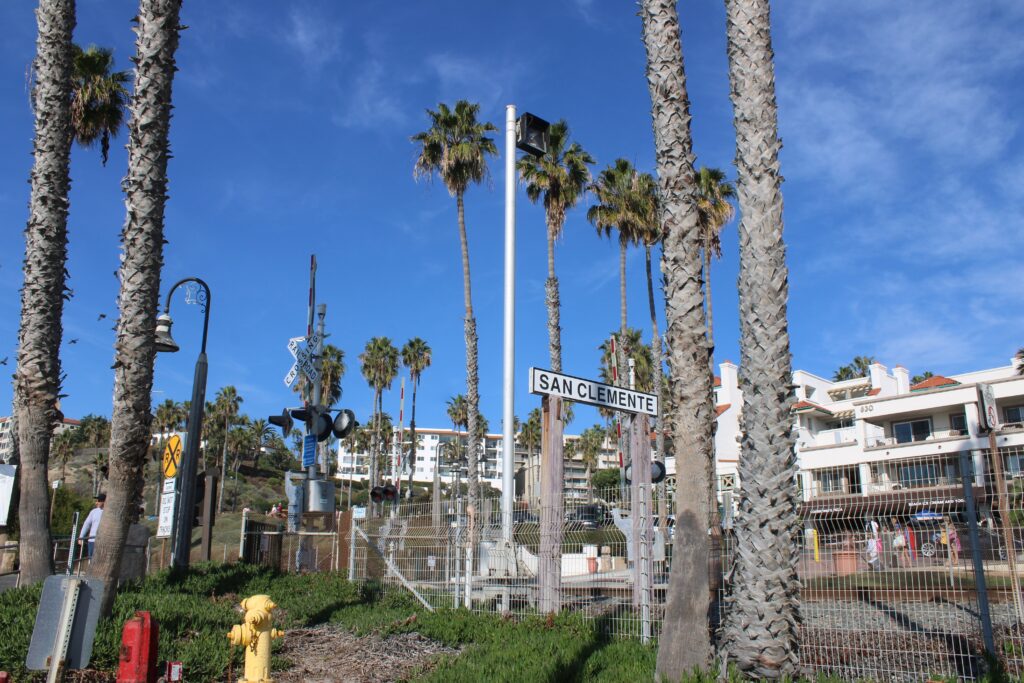
California Vehicle Code Section 21950 requires every driver to yield the right-of-way to a pedestrian crossing within a crosswalk at an intersection — and critically, this applies whether or not the crosswalk is actually painted on the pavement. An “unmarked crosswalk” legally exists at essentially every intersection where a sidewalk meets a roadway, even without any visible markings. This surprises a lot of people, on both sides: plenty of drivers assume pedestrians only have the right-of-way where there are painted lines, and plenty of pedestrians don’t realize they’re legally protected at an unmarked intersection corner.
The statute doesn’t stop at simply requiring a driver to yield — it goes further. Under CVC 21950(c), drivers approaching any pedestrian in a crosswalk must exercise “due care” and reduce speed or take other necessary action to protect the pedestrian’s safety, regardless of who technically has the right-of-way at that instant. In practice, this means a driver can’t fully escape responsibility simply by arguing a pedestrian technically shouldn’t have been there — the law places an independent, ongoing duty of care on drivers near crosswalks.
What Happens Outside a Crosswalk
Not every pedestrian movement near the Pier happens at a marked intersection — a lot of foot traffic crosses mid-block, particularly along the stretch of road paralleling the beach where people are moving between parking, the sand, and nearby shops. Here, a different rule applies. Under CVC 21954, a pedestrian crossing outside of a crosswalk must yield to vehicles that are close enough to present an immediate hazard.
It’s worth understanding a related but distinct point: since January 1, 2023, California’s Freedom to Walk Act (Assembly Bill 2147) has prohibited police from citing a pedestrian for jaywalking as long as the crossing is done safely, without creating an immediate danger of a collision. This decriminalized casual mid-block crossing when it’s genuinely safe to do so, but it did not eliminate the underlying yielding duty pedestrians carry under CVC 21954, and it did not change how fault gets analyzed in an injury claim. A pedestrian who crosses mid-block and is struck by a car can still bear a share of responsibility for the accident under California’s comparative negligence framework — the change in the law affects criminal citations, not civil liability.
How This Plays Out Specifically Around the Pier and Pier Bowl
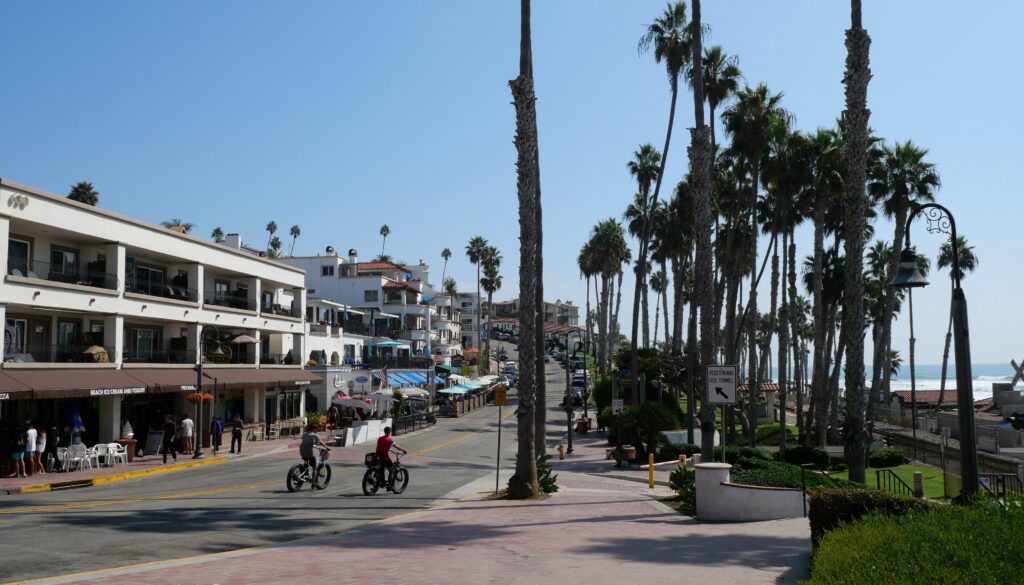
The area around the Pier and Pier Bowl has a fairly unique mix of pedestrian behavior that’s worth understanding in the context of these rules. Surfers frequently cross the road at informal points near the Pier Bowl to reach the water, often carrying boards that limit their ability to react quickly to traffic. Families and beachgoers move steadily between beach parking areas and the sand throughout the day, sometimes at marked crosswalks and sometimes not. And in the evenings, particularly after events at the Pier or nearby Linda Lane Park, pedestrian volume spikes sharply as crowds disperse at once, often in reduced light.
Each of these patterns interacts with the legal framework differently. A surfer crossing at an unmarked intersection corner still has the right-of-way under CVC 21950, even carrying a board and even without a painted crosswalk. A beachgoer crossing mid-block between two intersections is subject to the yielding requirement under CVC 21954, even though they won’t be criminally cited for doing so as long as it’s done safely. And a driver navigating this area at any time of day carries an independent duty of care toward pedestrians, separate from the specific right-of-way rules, given how well-known this stretch of road is for heavy foot traffic.
Special Protections Worth Knowing
A few additional rules apply specifically in situations that come up around a busy pedestrian area like this one:
- Sidewalk crossings. Under CVC 21952, a vehicle crossing a sidewalk — for example, pulling into or out of a beachfront parking lot or driveway — must always yield to pedestrians on that sidewalk. This is a common source of collisions near the Pier, where numerous parking areas and driveways cross directly over sidewalks used by heavy foot traffic.
- Blind pedestrians. CVC 21963 gives pedestrians using a cane or guide dog the right-of-way at all intersections, and requires drivers to take extra precautions around them.
- Skateboards and similar devices. California law generally treats a person on a skateboard or similar non-motorized device as a pedestrian for right-of-way purposes in these contexts, which is relevant given how common skateboarding is in the Pier Bowl area.
Parking Lot and Driveway Accidents Near the Pier
A meaningful share of pedestrian accidents in this area don’t happen at intersections at all — they happen in the beach parking lots and driveways that line the road near the Pier. Under CVC 21952, a vehicle crossing a sidewalk to enter or exit a driveway or parking lot must yield to any pedestrian on that sidewalk, a rule that applies whether the pedestrian is visible from a distance or steps into view suddenly from behind a parked car or landscaping. Backing accidents are a particularly common pattern in this setting: a driver backing out of a beachfront parking space, focused on other vehicles rather than pedestrians walking along the row, can easily miss someone approaching from the side. Because visibility is often genuinely limited in these situations — parked cars, beach umbrellas, and coolers all obstruct sightlines — these cases frequently come down to a factual question of how much warning a driver reasonably had, rather than a clean right-of-way dispute.
Nighttime and Low-Visibility Risk
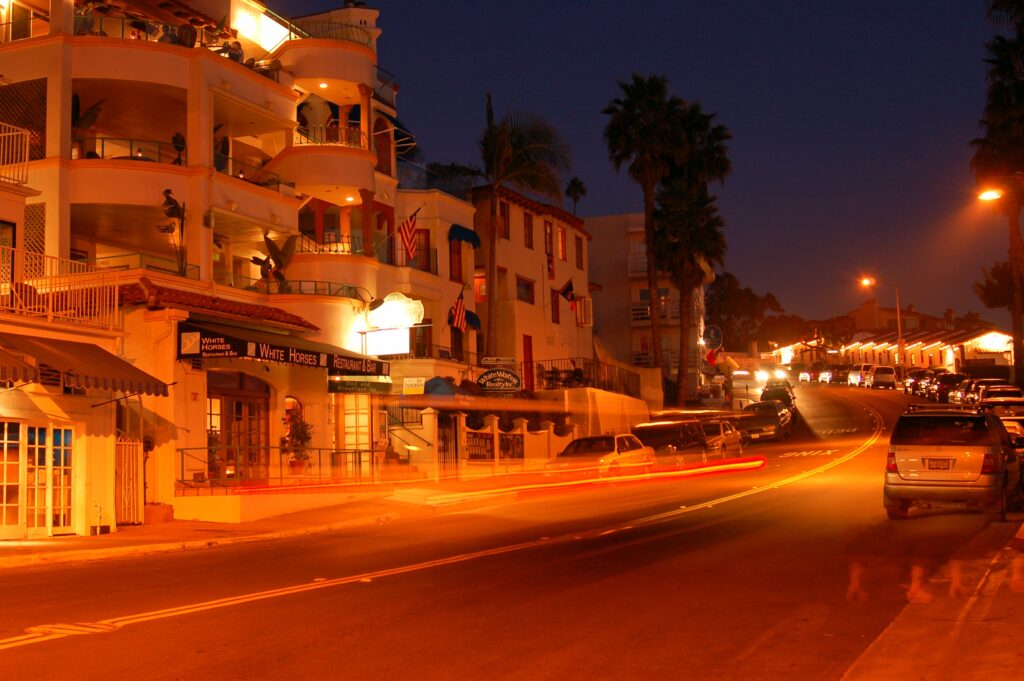
Foot traffic near the Pier doesn’t stop when the sun goes down, particularly during summer evenings, after Thursday concerts, or during Ocean Festival weekend. Pedestrian visibility drops considerably after dusk, and a driver’s independent duty of care under CVC 21950(c) becomes especially significant here — a driver navigating this area at night is expected to slow down and account for the real possibility of pedestrians crossing outside of well-lit areas, given how well-established this stretch of road is as a heavy pedestrian corridor. Wearing light-colored or reflective clothing, and using marked crosswalks when possible after dark, are reasonable precautions for pedestrians, but they don’t shift the underlying legal duty away from drivers to remain alert in an area they should reasonably expect to encounter foot traffic.
Surfers and Board Carriers: A Uniquely Local Consideration
One thing that sets the Pier Bowl area apart from a typical pedestrian corridor is the volume of surfers crossing the road with boards in hand, often before dawn or during peak surf conditions regardless of time of day. Carrying a surfboard limits a person’s ability to see clearly in all directions and to react quickly if a car approaches unexpectedly, which is worth factoring into how both drivers and surfers themselves think about these crossings. Legally, a surfer crossing the road is simply a pedestrian for right-of-way purposes — the same CVC 21950 and CVC 21954 framework applies regardless of what someone is carrying — but from a practical safety standpoint, both surfers and drivers benefit from treating these crossings with extra caution, particularly at the informal, frequently-used crossing points near the Pier Bowl that aren’t always at a formal intersection.
Cyclists and Skateboarders Sharing the Same Space
Because the Pier area draws heavy bicycle, e-bike, and skateboard traffic in addition to pedestrians, accidents here sometimes involve disputes over which category of road user someone falls into for right-of-way purposes. California generally treats a skateboarder on a sidewalk or crossing as a pedestrian, while a cyclist is treated more like a vehicle operator under most circumstances — a distinction that can matter when sorting out fault in a three-way interaction between a car, a cyclist, and a pedestrian near the same crossing point. If your accident near the Pier involved more than just you and a car — for example, a cyclist swerving to avoid a pedestrian and colliding with a vehicle as a result — the legal analysis can involve layered duties owed by multiple parties rather than a single straightforward right-of-way question, which is exactly the kind of situation where professional guidance helps sort out where responsibility actually lies.
What Compensation Covers in a Pedestrian Injury Claim
Pedestrian accidents often result in more serious injuries than vehicle-to-vehicle collisions, given the complete absence of any protective structure around the injured person. California law allows an injured pedestrian to seek compensation for medical expenses (both incurred and reasonably anticipated future costs), lost wages and diminished earning capacity if the injury affects your ability to work, and pain and suffering, among other damages. In more serious cases involving long-term or permanent injury, the value of a claim can also account for changes to quality of life and the cost of ongoing care. Because pedestrian injuries frequently involve fractures, head trauma, or other injuries with delayed or evolving symptoms, prompt and thorough medical evaluation isn’t just about your health — it also creates the documentation that supports the full scope of a claim later.
What to Do If You’re Involved in a Pedestrian Accident Near the Pier
- Seek medical attention immediately, even for what feels like a minor impact. Pedestrians absorb the full force of a collision without any of the protection a vehicle provides, and injuries — particularly to the head, hips, and legs — can be more serious than they initially seem in the adrenaline of the moment.
- Note exactly where the crossing occurred. Because the legal analysis differs meaningfully between a marked crosswalk, an unmarked crosswalk at an intersection, and a mid-block crossing, an accurate account of your exact location — which corner, how far from the nearest intersection — matters more here than in many other kinds of accidents.
- Get witness information if you can. The Pier area is almost always populated, which means there’s a good chance someone saw what happened. Given how much a pedestrian case can turn on exactly who had the right-of-way at that moment, an independent witness account carries real weight.
- Check for nearby surveillance footage. Many of the businesses along Avenida Del Mar and near the Pier maintain security cameras, and footage from a nearby storefront can sometimes provide the clearest evidence of exactly how a pedestrian accident unfolded.
- Don’t assume comparative fault ends your claim. Even if you were crossing mid-block, or otherwise didn’t have technical right-of-way at the moment of the accident, California’s pure comparative negligence rule means you can still recover compensation, reduced by your own share of fault — and a driver’s independent duty of care under CVC 21950(c) often means more responsibility falls on the driver than people initially assume.
Walk the Pier With Confidence, and Know Your Rights
The Pier and Pier Bowl area is one of San Clemente’s defining places, and the vast majority of the people who walk it every day do so without incident. But because pedestrian right-of-way law in California is more nuanced — and more protective — than most people realize, it’s worth understanding before you need it, whether you’re a lifelong local walking the same route every morning or a visitor here for the day.
If you or someone you know has been injured as a pedestrian near the Pier or anywhere in San Clemente, Rosen Law Offices offers free consultations to help you understand your rights. Call us at (949) 335-0020.
This article is intended for general informational purposes and does not constitute legal advice. Every accident involves unique facts, and the outcome of any claim depends on the specific circumstances involved. If you’ve been injured, consult with a licensed attorney about your particular situation.